
Agro Fibers:
Packaging and Fiberboard
Most factory projects start with a product. The client knows what they want to make, and the question is how to make it best.
This project started somewhere else.
The client came to us with a raw material and asked us to figure out what to make of it.
They had access to a steady supply of agricultural fibers, which would otherwise have gone to waste as a by-product.
Their question was simple.
Could these fibers be used to make pulp moulded packaging?
And if not, was there something else they could be turned into, using whatever technology happened to exist out there?
It was an open brief, which is unusual and useful. There were no preset answers to defend, no sales pitches to push past. The starting point was the material itself, and what it could do.
The challenge was that agricultural fibers aren't all the same. Different fibers behave differently in pulping, moulding, drying, and pressing. The off-the-shelf pulp moulded packaging process is built around a few well-known fiber types. Step outside those and you can quickly find that the process needs adjusting, the equipment needs changing, or that the standard approach simply doesn't suit the material at all.
So we started by testing what was actually in front of us.
We ran trials on the fibers with different pulping methods, additives, moulding setups, and drying parameters. The first few rounds told us where the difficulties were going to be. Some properties of the fibers were excellent. Others were going to need careful handling to get a usable result.
That's where the research part of the work started.
The standard pulp moulded packaging process wasn't going to work as it was. We needed to find processes and equipment that could handle this particular fibre type without giving up on product quality or production economics. The catch was that the most suitable technologies for this kind of material weren't in mainstream catalogues. They're used by a small number of specialized operators, often developed for niche applications, and they don't usually surface in standard supplier conversations or a quick web search.
This is where the years of work we'd already put into sustainable packaging innovations came in. Through our network and ongoing research, we were able to identify processes that could handle the fibres properly. After more testing with these alternative approaches, we produced successful pulp moulded packaging samples that the client could actually take to market.
But while we were working through the material, something else came up.
The fibers weren't only suited to pulp moulding. As we tested how they behaved under different conditions, it became clear that they could also be used to produce fiberboards, the kind of panels used in the furniture industry. That wasn't part of the original brief. It hadn't even been on the table. It came up because we were running the material through different processes and watching what it did. A whole second application opened up, in a different industry, from the same raw material.
The client now has more options than they came in with.
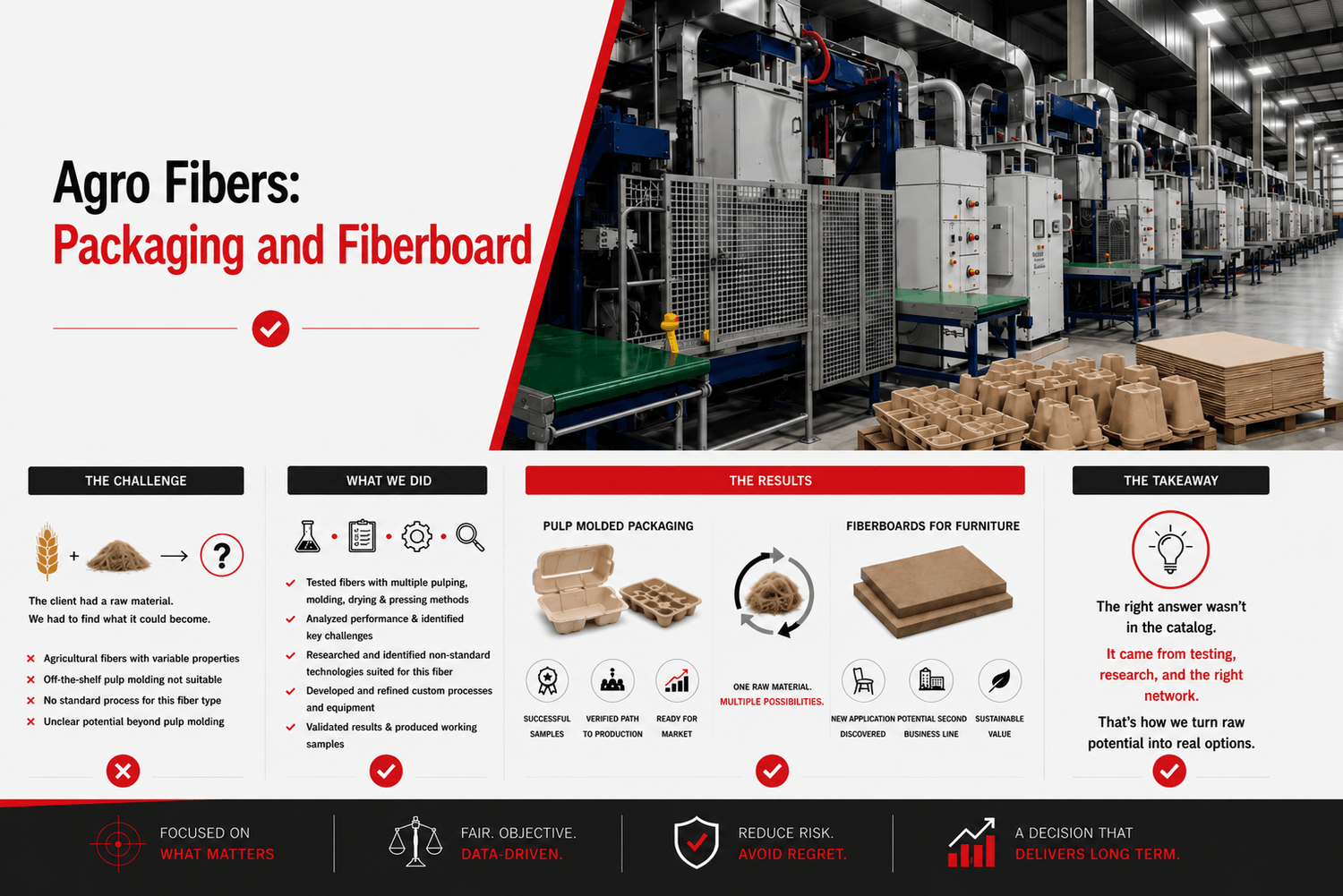
Successful pulp moulded packaging samples, a verified path to commercial production, and a second potential business line in fiberboards for furniture.
What the client walked away with was clear. Working samples, a path to commercial production, and a second potential business in fiberboards. What's less visible from the outside is the network and the years of quiet research that made it possible to find the right technologies in the first place.
Without that, none of the rest happens.