
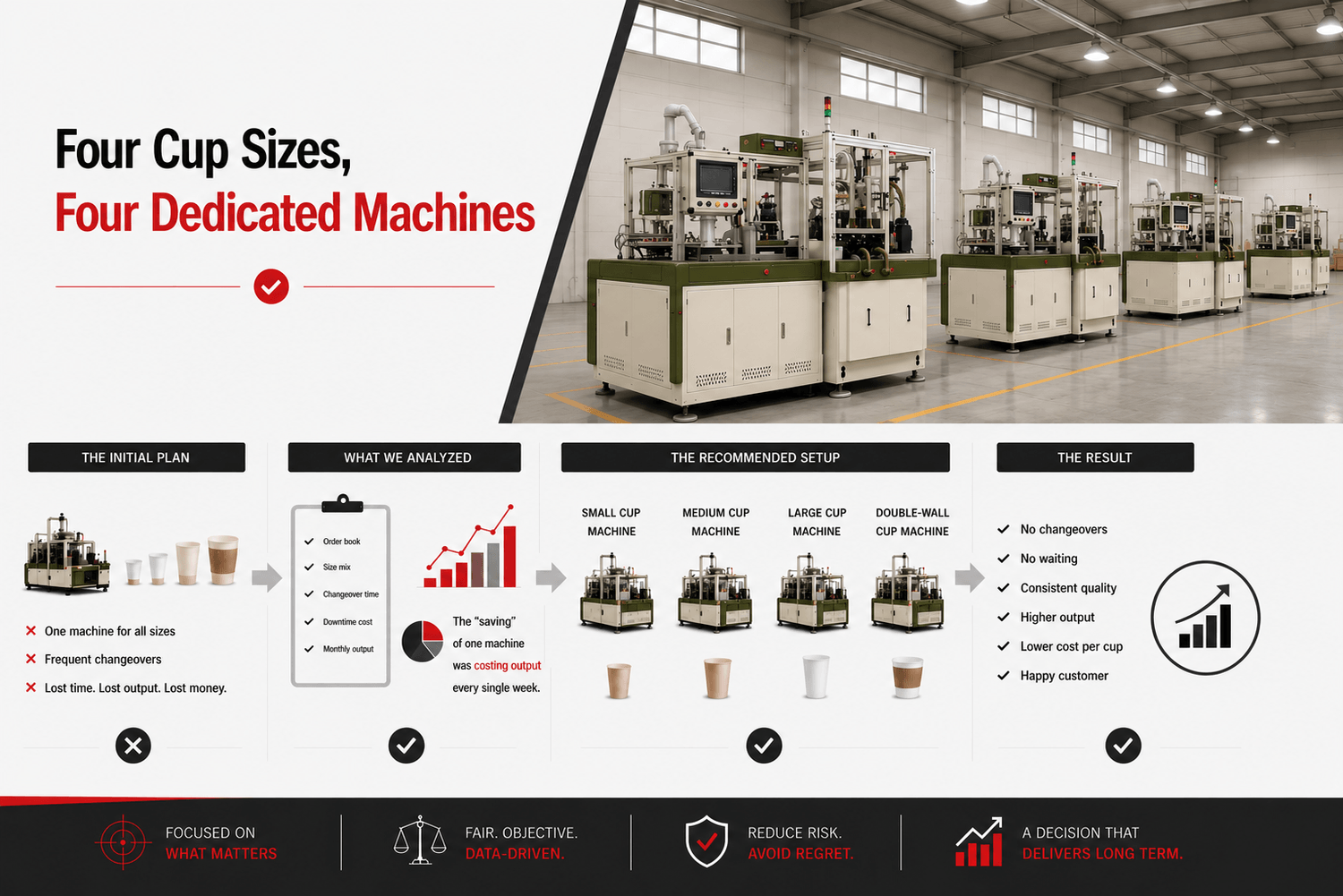
Four Cup Sizes,
Four Dedicated Machines
In almost every factory planning conversation, someone in the room asks the same question.
Can we do this with fewer machines?
It's a fair question. Machines cost money. Floor space costs money. Every extra machine you bring in adds spare parts, technicians and training to the bill. So when a supplier says, "this one machine can make all your cup sizes," it sounds like the right answer. One machine. One operator. One service contract. Easy.
Our client started in exactly that place. They were planning a paper cup factory, and their first thought was simple. Buy one machine that could make every cup size they wanted to sell. The numbers looked clean. Less to spend. Less to manage. Less to maintain.
For a small operation, that thinking can work.
This wasn't going to be a small operation.
When we sat with the team and looked at what their order book would actually look like once they went live, things changed. The market wanted small cups, medium cups, large cups, and double-wall cups for hot drinks. Orders for different sizes were going to come in every week, sometimes on the same day, sometimes in the same shipment. Running that on one machine meant stopping the line and changing the tooling every time a size changed. And those changeovers aren't quick. They take hours. They waste paper. The first batch after a changeover usually has quality issues that need to be sorted out before the line settles. Do that often enough and it stops being a small inconvenience. It becomes the thing that decides how many cups the factory can produce in a month.
The "saving" of buying one machine was quietly going to cost them output every single week.
So we suggested a different setup.
Instead of one machine trying to do everything, we recommended a separate machine for each cup size, and another one dedicated to double-wall cups, because the process for those is different. Yes, it meant more equipment to buy. Yes, it meant more floor space. But each machine could now run its own product without stopping.
No retooling. No waiting. No quality problems from constant changeovers.
The client thought about it carefully. It's not an easy idea to accept at first. You're being told to spend more upfront so the business can earn more later, and that always sounds like a sales line until you see the actual numbers. We walked them through it, side by side. How many cups each setup could produce in a month. How many hours would be lost to changeovers. What every one of those lost hours was really costing them.
They went with the "dedicated machines" setup.
The factory is running today, and the difference is easy to see when you walk onto the floor. The lines don't stop. Operators aren't standing around waiting for a tooling change. Each machine runs its own product all day, and the quality stays steady because nothing is being interrupted. Output matches the business plan, which is rarer than it sounds. Rejects are low. The team isn't running around fixing problems.
And the client didn't have to learn any of this the hard way.
That's the real value here. Some mistakes in factory planning can be fixed later. The machine strategy is not one of them. Get it wrong on day one and you spend the next few years working around it.