
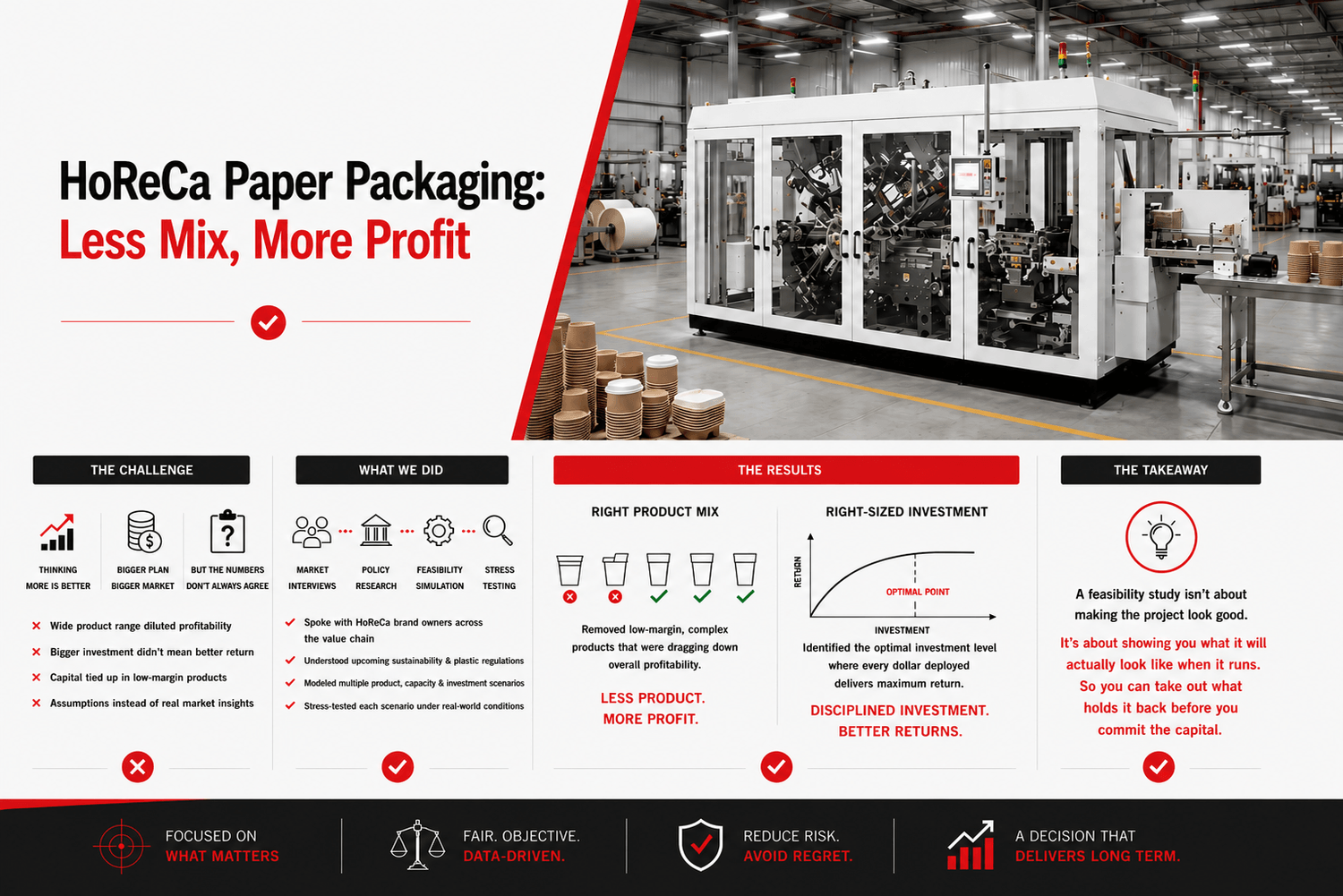
HoReCa Paper Packaging:
Less Mix, More Profit
In most business plans, more sounds better than less. More products in the range. More capacity to scale into. More capital deployed up front. The thinking is simple. A bigger plan wins a bigger market.
The numbers don't always agree.
Our client came to us at exactly that planning stage. They were already an established plastic packaging manufacturer, and they wanted to diversify into paper packaging products for the HoReCa sector. That meant hotels, restaurants, and cafes. A market that was shifting fast.
The shift made business sense. Sustainability pressure was growing. Single-use plastic regulations were tightening. The brands they served were already asking for paper alternatives.
The question wasn't whether to do it. The question was how to do it well enough to take to their board with confidence.
That's what they engaged us for. A market study and a project feasibility report that they could put in front of an investment committee.
We started by going outside the office.
A feasibility report built only on internal assumptions tends to look good on paper and miss the things that matter in practice. So we spent the first weeks listening. We spoke to brand owners across the HoReCa value chain to understand what packaging they were buying, what they were moving away from, and what changes they expected over the next few years. We spoke to policymakers to understand how upcoming regulations on sustainability and single-use plastics would actually land. Which categories would be affected, when, and how quickly. That part matters, because regulations don't apply to every product equally. A ban on one type of plastic packaging can be a big opportunity for one paper category and almost no opportunity for another.
Once we had that picture, we ran the project through our dynamic feasibility simulator.
This is where things started behaving differently than the client had expected.
The simulator is built to test a project under real conditions, not ideal ones. It lets us model different product combinations, different capacity levels, different capital investments and different stress scenarios, and then watch what happens to the financials in each version. We didn't run one feasibility. We ran many. Then we stress-tested each one against volume drops, price pressure, and slower ramp-up.
A few clear insights came out of it.
The first was about products. The client's original plan included a wide product mix because, on the surface, more products meant more revenue lines and more flexibility. The simulator told a different story. Two or three of the products in the original list were actually pulling the project's profitability down. They needed extra equipment, they took up production time, and they competed for capital, without bringing in enough margin to justify their place. When we modeled the same project without them, the numbers improved significantly. Less product, more profit.
The second was about capital. The client had assumed that the bigger the investment, the better the return. The simulator showed where that assumption broke. Beyond a certain level of investment, every extra dollar was bringing back less than the one before it. More money in didn't mean more money out. There was a right size for this project, and it wasn't the biggest size.
We presented the full study with the recommended product mix, the right-sized investment, and the stress-tested financials behind both.
The client took it to their board and got the clarity they needed to move forward.
That's the real point of a feasibility study. It isn't there to make a project look attractive. It's there to show you what the project will actually look like once it's running, and to help you take out the parts that will weigh it down before you commit the capital.