
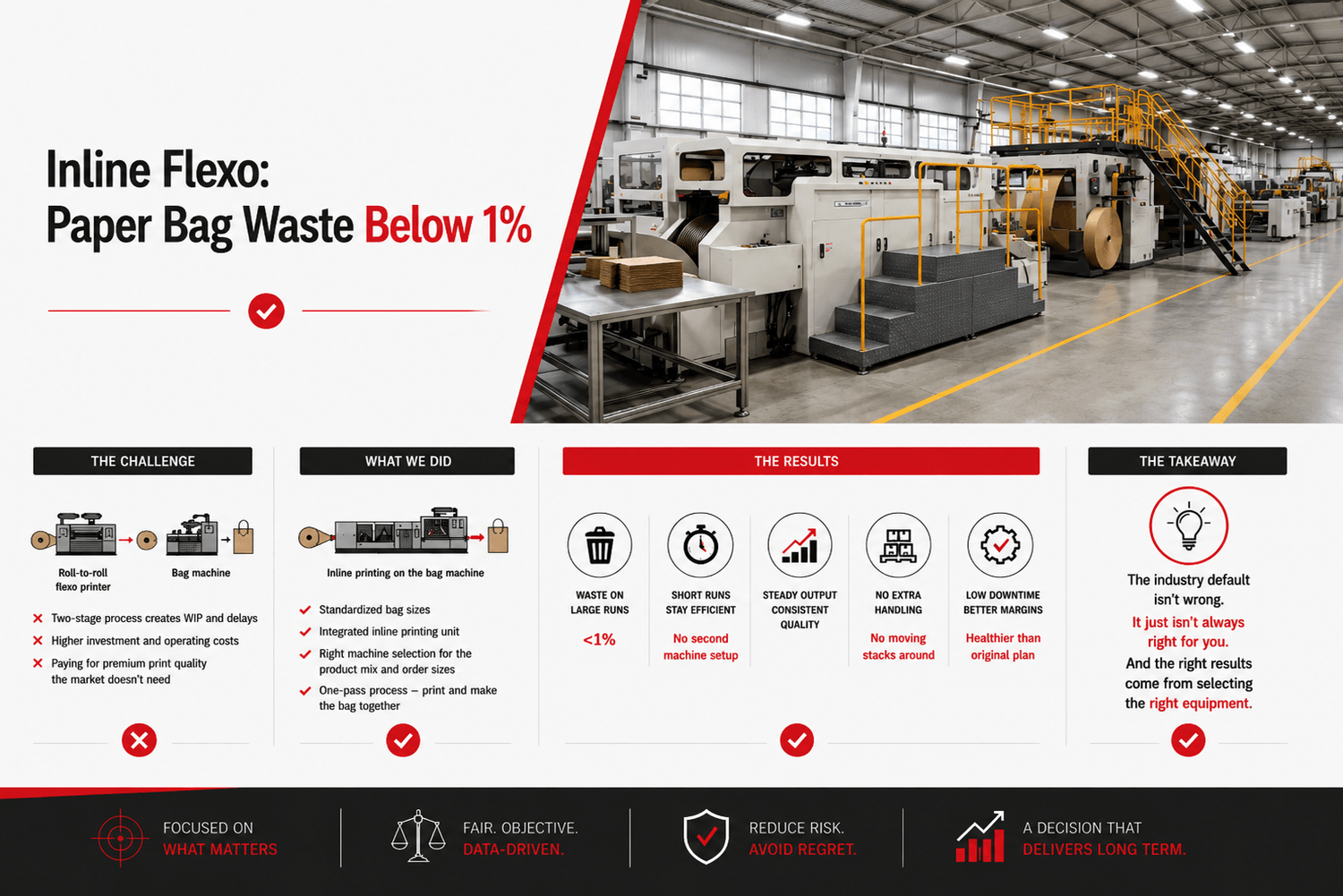
Inline Flexo:
Paper Bag Waste Below 1%
There's a good reason most paper bag factories print their bags offline.
A roll-to-roll flexographic printer can run about three times faster than a bag-making machine. So if you print the rolls first, on a separate machine, and then feed those printed rolls into the bag line, you're using your printer at full capacity instead of letting it wait around for the slower bag machine. It makes clean industrial sense.
That's why it became the standard.
Our client started in the same place. They were planning a paper bag factory and the early plan followed the industry default.
Buy a bag machine. Buy a separate roll-to-roll flexo printer. Run them as two stages, with printed rolls queued up in between.
It would have worked. It works for plenty of factories.
But before we agreed to it, we wanted to ask a smaller question.
Was it really the right setup for this client?
So we sat with the team and looked at the product they were going to sell. What did their market actually care about? What were buyers willing to pay for? What were they not willing to pay for? When we worked through it, the answer came back clearer than expected. The bags this client was going to make didn't need the kind of print quality that a high-end roll-to-roll flexo is built to deliver. What their customers really wanted was a good, strong, well-made bag at a competitive price. Print quality mattered, but not at premium levels.
That changed the picture.
A high-productivity offline flexo printer is excellent equipment. But for this client, it was going to deliver a level of print quality they weren't being paid for, at a cost they couldn't easily carry. The standard setup, as good as it is, was overkill for this particular product.
So we recommended a different route. Standardize the bag sizes, and put the printing unit directly on the bag machine, inline, so the bag is made and printed in a single pass.
Here's where most factories get into trouble.
Inline printing on a bag machine sounds simple, but plenty of these setups underperform in real life. The reason is almost always the same. People pick the wrong models. The bag line and the inline printer have to be matched carefully, both to each other and to the type of bag being made. Get that selection wrong and the line runs slowly, the print quality suffers, and the project ends up with a setup that's worse than the standard one it was trying to improve on.
That selection work is where we spent most of our time. We weren't just choosing inline over offline. We were choosing the right bag line, the right inline printing unit, and the right configuration for this client's product mix and order sizes. That's the part that's easy to underestimate, and it's usually why inline projects fail when others try to copy the idea without doing the work behind it.
Once that selection was right, the rest of the project came together quickly.
The factory has been running on the inline setup for some time now. Waste on large runs has dropped below 1%. Short runs stay efficient because there's no second machine to set up. Output is steady. Quality is consistent. The team isn't moving stacks of bags from one part of the floor to another all day. Downtime is low. Margins are healthier than the original plan expected.
If there's a lesson in this one, it's a simple one.
The industry default isn't wrong. It just isn't always right for you.
Switching to a different setup only works if you put the same care into picking the equipment as you put into picking the strategy.